

 Login
Login


 March 23, 2026
|
Voiced by Amazon Polly |
Introduction
When building applications on AWS, one of the most common questions developers and architects face is: Which compute service should I use?
AWS offers multiple compute options, including Amazon EC2, Amazon ECS, Amazon EKS, and AWS Lambda. Each service is powerful, but choosing the wrong one can lead to unnecessary complexity, higher costs, or operational challenges.
In this blog, we’ll break down these services in a simple, practical way, explain what each one does, where it fits best, and how to decide which option works best for your use case.
Pioneers in Cloud Consulting & Migration Services
- Reduced infrastructural costs
- Accelerated application deployment
AWS Compute Services
AWS compute services provide the resources needed to run applications, APIs, background processes, and workloads in the cloud.
Instead of managing physical servers, AWS offers multiple compute options that vary in how much control and management you handle versus how much AWS manages for you.
Amazon EC2, Amazon ECS, Amazon EKS, and AWS Lambda represent different levels of control, flexibility, and abstraction within this compute spectrum.
Amazon EC2
Amazon Elastic Compute Cloud (Amazon EC2) provides virtual servers in the cloud, with full control over the operating system and environment.
Key Features and Benefits:
- Full Control Over Infrastructure: You control the operating system, runtime, software, networking, and security configurations.
- Flexible Instance Types: Choose from a wide range of instance types optimized for compute, memory, storage, or networking.
- Custom Configurations: Ideal for legacy applications or workloads that require specific OS-level customizations.
- Integration with AWS Services: Works seamlessly with services like Elastic Load Balancing, Auto Scaling, Amazon EBS, and Amazon CloudWatch.
Amazon ECS
Amazon Elastic Container Service (Amazon ECS) is a fully managed container orchestration service that helps you run Docker containers without managing servers manually.
It abstracts away much of the infrastructure complexity while keeping things simple.
Key Features and Benefits:
- Simple Container Management: Amazon ECS makes it easy to run, stop, and scale containerized applications.
- Tight AWS Integration: Native integration with AWS IAM, Amazon CloudWatch, Application Load Balancer, and Amazon VPC networking.
- Flexible Launch Types: Run containers on Amazon EC2 instances or go serverless with AWS Fargate.
- Lower Operational Overhead: No need to manage Kubernetes control planes.
Amazon EKS
Amazon Elastic Kubernetes Service (Amazon EKS) is AWS’s managed Kubernetes service.
It’s designed for teams that want the power and flexibility of Kubernetes with AWS-managed infrastructure.
Key Features and Benefits:
- Managed Kubernetes Control Plane: AWS manages the availability, scaling, and security of the Kubernetes control plane.
- Portability and Standardization: Ideal if you want Kubernetes portability across cloud providers or on-premises environments.
- Strong Ecosystem Support: Supports tools like Helm, kubectl, Prometheus, and other Kubernetes-native solutions.
- Scales for Large Workloads: Well-suited for complex microservices architectures.
AWS Lambda
AWS Lambda is a serverless compute service that lets you run code without provisioning or managing servers.
You simply upload your code, and AWS handles everything else.
Key Features and Benefits:
- No Server Management: No servers, no operating systems, and no scaling decisions to manage.
- Automatic Scaling: Scales automatically based on the number of incoming requests.
- Pay Only for Execution Time: You are charged only for the time your code runs.
- Event-Driven Architecture: Integrates easily with Amazon S3, Amazon API Gateway, Amazon DynamoDB, Amazon EventBridge, and more.
How to Choose the Right Compute Service?
Each service fits different requirements. Here’s a practical comparison:
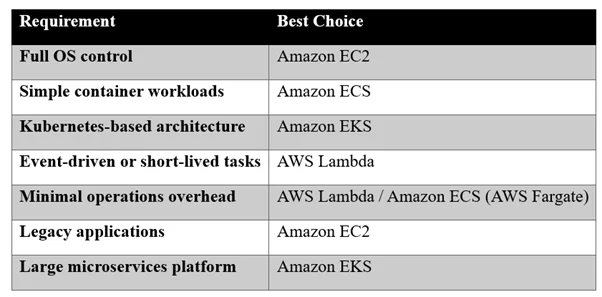
Real-World Examples
- Startup API Backend: AWS Lambda with Amazon API Gateway is ideal for fast development and low cost, eg, food delivery and ride booking APIs.
- E-commerce Platform: Amazon ECS with AWS Fargate provides container scalability without managing servers, eg, large online retail platforms.
- Enterprise Microservices: Amazon EKS enables Kubernetes-based deployments with standardized tooling, eg, fintech and banking microservices.
- Legacy Application Migration: Amazon EC2 allows lift-and-shift migrations with minimal code changes, eg. ERP and legacy enterprise systems.
Cost
Each service follows a different pricing model:
- Amazon EC2: You pay for instance uptime, storage, and data transfer.
- Amazon ECS: There is no additional charge for Amazon ECS itself; you pay for Amazon EC2 or AWS Fargate usage.
- Amazon EKS: Charged per cluster per hour, plus worker node costs.
- AWS Lambda: You pay only for execution time and the number of requests.
Choosing the right service can significantly reduce cloud costs.
Conclusion
There is no single “best” compute service on AWS-only the right service for the right use case.
- Amazon EC2 gives you control
- Amazon ECS simplifies container management
- Amazon EKS powers Kubernetes workloads
- AWS Lambda removes infrastructure concerns entirely
Drop a query if you have any questions regarding AWS Compute Services and we will get back to you quickly.
Empowering organizations to become ‘data driven’ enterprises with our Cloud experts.
- Reduced infrastructure costs
- Timely data-driven decisions
About CloudThat
FAQs
1. Is AWS Lambda better than Amazon EC2?
ANS: – Not always. AWS Lambda is great for event-driven workloads, but Amazon EC2 is better for long-running or stateful applications.
2. Do I need Kubernetes to use containers on AWS?
ANS: – No. Amazon ECS is simpler and works well for most container workloads.
3. Is Amazon EKS expensive?
ANS: – Amazon EKS has additional costs and operational complexity, so it’s best for teams that truly need Kubernetes.


WRITTEN BY Parth Thakkar
Parth Thakkar is a Research Associate at CloudThat. He enjoys learning new technology and working on impactful projects. He’s always excited to solve problems and create practical solutions.


 PREV
PREV








Comments